
Is Fall the Right Time to Aerate Commercial Turf in DFW?
A practical guide for DFW property managers deciding whether compacted turf needs aeration now, later, or not at all.
Published September 30, 2026 · Land Care Landscape Management
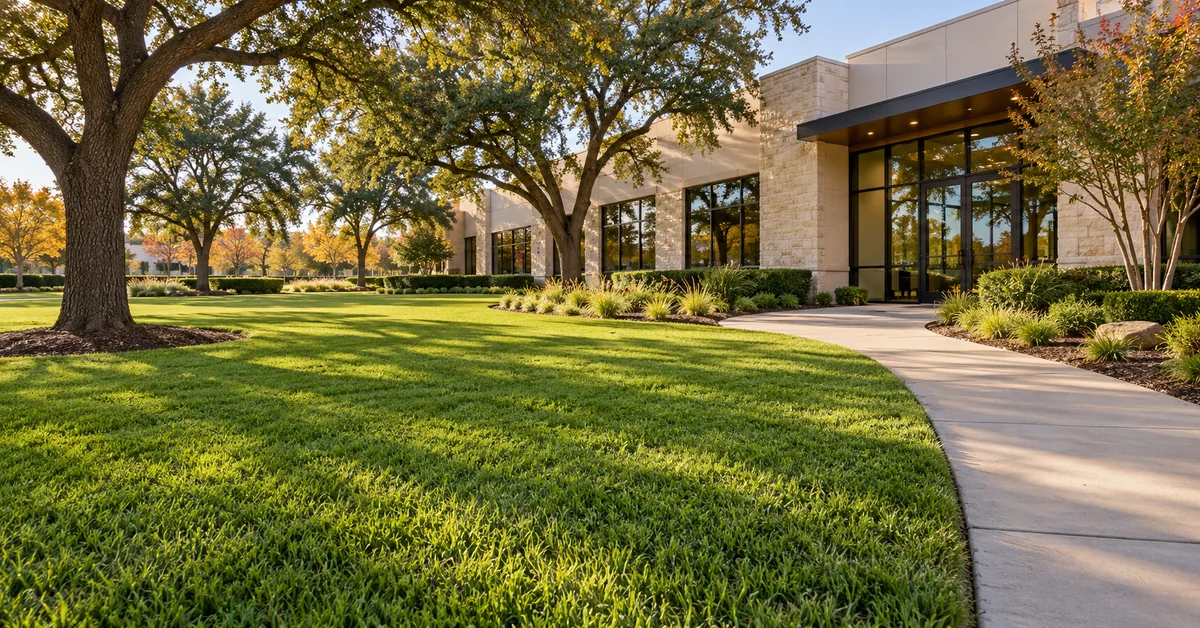
AI-generated illustrative image. It does not depict a Land Care Landscape Management project.
Sometimes. Texas A&M's bermudagrass home-lawn calendar includes September and October when soil moisture supports core removal. Its St. Augustinegrass guidance favors spring and early summer. Land Care's Aeration page favors late spring through summer for warm-season turf. For a DFW commercial property, confirm species, compaction, and recovery before scheduling.[2][3]
For a commercial property, the useful question is not just whether aeration appears on a seasonal checklist. It is whether the affected turf needs it, whether the site can recover, and whether the work can be planned around entrances, tenant activity, irrigation equipment, and other property operations.
What does aeration help address?
Texas A&M's St. Augustinegrass guidance says compacted soil can limit infiltration and root growth; aerification is its primary cultivation practice for that condition.[3] Land Care's DFW clay-soil guide covers why commercial turf with real foot and equipment traffic needs aeration on the annual planning schedule. This article focuses on the next question: which turf areas can benefit now, and when can that grass recover?
Do not assume every thin patch is compacted. Compare the affected area with nearby healthy turf and check whether drainage, shade, irrigation coverage, or wear might explain the pattern before choosing work.
Which parts of a commercial site should you inspect first?
Begin where repeated traffic is concentrated: main pedestrian approaches, frequently used cut-throughs, loading or service edges, and gathering areas. Note where thinning or poor water entry repeats, then compare those locations with lower-traffic turf. Bermudagrass is a warm-season species known for traffic tolerance and recovery, but that does not establish that every property has bermudagrass or that every worn area is compacted. See AggieTurf's bermudagrass profile for the species characteristics.[1]
A useful inspection record can include:
- The turf species, if it can be identified with confidence.
- The location and size of each stressed or heavily used area.
- Whether the same pattern appears in adjacent, lower-traffic turf.
- Recent irrigation performance, drainage observations, shade, and visible signs that may point to another cause.
- Nearby irrigation heads and lines that must be protected before mechanical work.
Texas A&M's St. Augustinegrass guidance advises taking irrigation lines and heads into account before cultivation.[3] The property map and irrigation plan should be part of the work review, not an afterthought.
When can fall be an appropriate time?
Texas A&M's Bermudagrass Home Lawn Management Calendar shows an aeration window from April through October, which includes September and October. It describes aeration to relieve compaction, especially where turf receives moderate to heavy use, and says soil needs enough moisture for the tines to remove a core. The calendar cautions that practices vary by site and region. This is home-lawn guidance, not a commercial-property specification.[2]
For St. Augustinegrass, Texas A&M's species guidance recommends cultivation in spring and early summer when the grass is actively growing and able to recover quickly.[3] Land Care's own Aeration service guidance favors late spring into summer for warm-season turf, including bermudagrass and St. Augustinegrass. That is a preferred general window; the bermudagrass home-lawn calendar also allows fall consideration. Neither source authorizes a fall pass on a specific property without confirming grass, compaction, moisture, growth, and recovery.
In practice, a fall walk can be valuable even when the right decision is to defer the work. Confirm the turf, document the affected zones, check soil moisture and irrigation constraints, and ask the landscape provider to recommend a timing window for that species. If the growth or site conditions do not support recovery, record the next suitable window instead of forcing a date.
Does the whole property need aeration?
Not necessarily. A compacted route or high-use lawn panel can be a localized issue. A mapped, targeted plan helps the manager compare the problem area with unaffected turf and avoid treating areas without an identified need. It also makes the next inspection more useful: the same locations can be checked again for turf recovery and continued wear.
Texas A&M describes aerification channels in the root zone in its St. Augustinegrass guidance.[3] That mechanism does not tell you whether a grading, drainage, or irrigation fault also needs attention. If water still collects, runs off, or misses a zone, ask for those conditions to be reviewed separately.
What should a property manager ask before approving the work?
Ask the provider to identify the turf species and the reason aeration is being recommended. Request a map of the proposed treatment areas, confirmation that irrigation heads and lines have been considered, and an explanation of why the proposed timing fits the turf's growth and the site's soil condition. For a multi-tenant property, also agree on access, work sequencing, and how the affected areas will be checked afterward.
These questions keep the decision tied to the property's actual conditions instead of a generic seasonal calendar. They also create a simple record for comparing the same high-use areas over time.
Frequently asked questions
Is fall always the best time to aerate?
No. Texas A&M's bermudagrass home-lawn calendar includes September and October, while its St. Augustinegrass guidance puts cultivation in spring and early summer.[2][3] Land Care's Aeration guidance favors late spring through summer for warm-season turf. On a commercial site, confirm the species, compaction, moisture, and ability to recover before deciding whether a fall pass is appropriate.
Will aeration fix every thin or worn area?
No. Aeration is intended to address compaction, but thin turf can have other causes. Compare the affected area with healthier turf and check for irrigation, shade, drainage, or plant-health issues before selecting a treatment. Texas A&M notes that cultivation is only one part of turf care in its St. Augustinegrass guidance.[3]
Should a manager request aeration across the full property?
Only if the inspection supports that scope. Map the repeated high-traffic areas, confirm the cause, and ask for a treatment plan that fits the specific turf and site rather than applying a blanket schedule.
For a commercial site walk, review Land Care Landscape Management's Aeration services and contact options. Request an estimate for one property; portfolio managers and formal bidders should use the commercial inquiry route shown on the contact page.
Sources
Plan a Turf Treatment Around Your Property
Ask for a site walk that identifies turf species, high-use zones, recovery timing, and the right scope before approving a fall pass.