
Why DFW Clay Soil Breaks Landscapes — and What Actually Fixes It
Expansive clay is the defining fact of DFW dirt: it swells when soaked, shrinks when baked, and moves whatever sits on it. Nearly every landscape problem that keeps recurring on a North Texas property traces back to it — and most of them are fixable once you stop treating symptoms.
Published July 27, 2026 · Land Care Landscape Management
What clay actually does
Clay particles hold water and expand, then contract hard as they dry. Across a Texas summer that cycle moves soil enough to crack slabs, tilt hardscape, tear irrigation lines, and open gaps along foundations. It also compacts under traffic until water cannot infiltrate at all — which is why irrigation runs off a compacted commercial lawn minutes after it starts while the turf underneath stays thirsty.
Reading the symptoms on your property
Standing water more than a day after rain. Turf strips that stay spongy while everything around them dries. Mulch washing out of the same bed every storm. Water staining on curbs and slab edges. Doors that stick seasonally. Thin, struggling turf in high-traffic paths. Each of those is a drainage or compaction signal, and each has a different correct fix — which is why diagnosis has to come before anyone sells you a solution.
Grading fixes what you can see
A surprising share of drainage problems resolve with grade correction alone: reshaping slope so water sheds away from structures and walks instead of pooling. It is the least glamorous fix and often the most durable, because it works with gravity instead of relying on hardware that can clog.
Drains fix what grading cannot reach
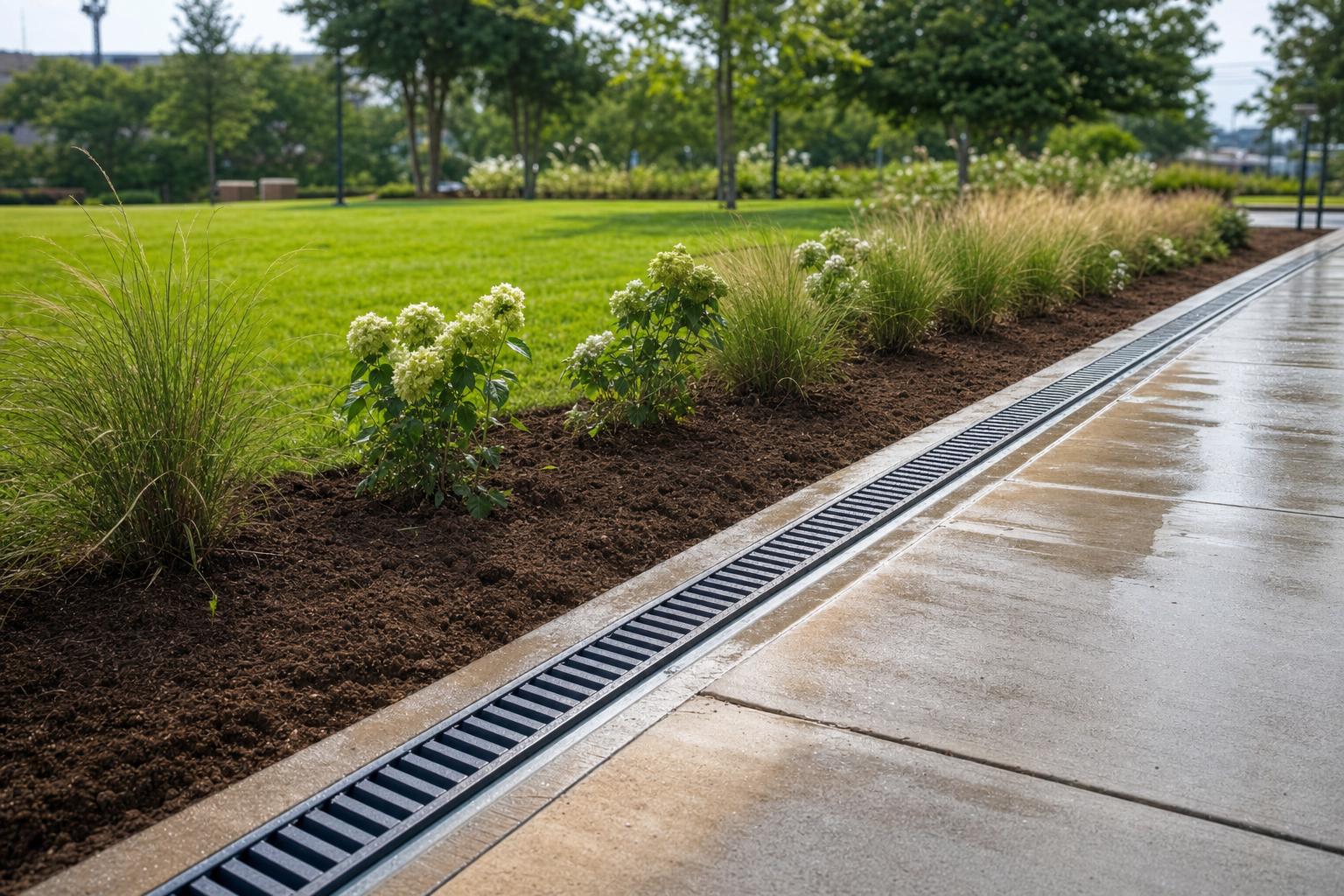
Where regrading has nowhere to send water, you need capture. Surface and area drains collect runoff you can see; channel drains handle sheet flow crossing drives and hardscape; French drains intercept saturation moving through soil where surface fixes cannot reach it. The failure mode is almost always the same — a trench installed without filter fabric, real slope, and a legitimate discharge point silts shut within a couple of seasons.
Aeration fixes the compaction half
Drainage work moves water off the property; aeration lets what remains actually reach roots. Core aeration physically removes plugs so air, water, and nutrition move through compacted clay, and it is the difference between fertilizer that works and fertilizer that runs off. On commercial turf with real foot and equipment traffic, it belongs on an annual schedule, not a wish list.
Plant for the soil you have
The last piece is species selection. Plants proven in alkaline North Texas clay establish and thrive; catalog selections chosen for a photograph struggle for three seasons and get replaced. That applies to turf varieties, shrubs, and especially trees — where a poor choice is a thirty-year mistake instead of a one-season one.
Questions about your property? Call or text (972) 919-0054 — we’ll walk it with you.
Related Services
Put These Standards to Work on Your Property
Tell us what you’re managing and what’s not working. We’ll walk it and bring you a straight answer.