
When to Fertilize Commercial Turf in North Texas: A Seasonal Schedule
A practical year-round fertilization calendar for warm-season commercial turf in North Texas, with a close look at what fall feeding should and should not do.
Published October 1, 2026 · Land Care Landscape Management
AI-generated illustrative image. It does not depict a Land Care Landscape Management project.
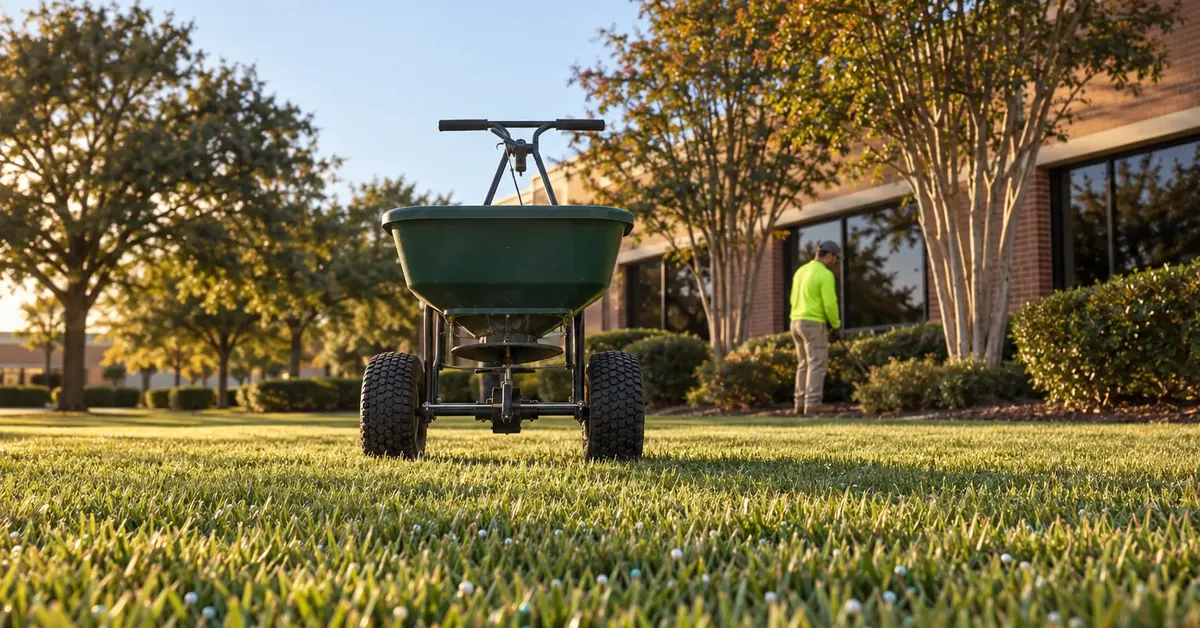
Warm-season turf in North Texas is fertilized when it is actively growing, roughly from April through early October. A typical program starts after spring green-up, repeats every six to eight weeks, eases off in the worst summer heat, and ends with a fall application at least four to six weeks before the first freeze.
When should warm-season turf be fertilized in North Texas?
The calendar matters less than what the turf is doing. Bermuda and St. Augustine, two of the most common warm-season grasses across North Texas commercial properties, only use nitrogen when they are growing. Feed them while dormant and you mostly feed winter weeds. Feed them too early in spring and a late cold snap can set the new growth back.
Two signals tell you the window is open. First, the turf has fully greened up, not just in the warmest corners of the property. Second, it has been through a couple of property mowing cycles. In most of the Dallas and Fort Worth area that lands somewhere between mid April and early May, a little earlier on south-facing slopes and parking lot islands that hold heat, and later in shaded or low spots.
The window closes in the fall. Late nitrogen pushes soft new growth right before frost, and that growth is the first to get damaged.
What does a month-by-month schedule look like for Bermuda and St. Augustine?
Every property is different, but this is the skeleton most North Texas programs are built on:
- Late February to mid March: Pre-emergent herbicide for summer weeds like crabgrass, applied as soil temperatures approach the mid 50s. No nitrogen yet, because the turf is still dormant.
- Mid April to early May: First fertilizer application once the turf has greened up and been mowed a couple of times. This is the main spring feeding.
- Late May to June: Second application, about six to eight weeks after the first. Bermuda in full sun responds strongly here. A second pre-emergent pass is common for sites with heavy weed pressure.
- July and August: Light feeding or none. If the turf is drought stressed, or the city has watering limits in effect, heavy nitrogen does more harm than good. On St. Augustine, iron is often used instead for color without forcing growth.
- September to early October: The final fertilizer application of the year, typically a potassium-leaning blend (see the fall section below), followed by or applied alongside a fall pre-emergent for winter weeds such as annual bluegrass and henbit, timed as soil temperatures fall into the 70s.
- November to February: Dormant season. No nitrogen. This is the time to scout for weeds, review the program, and plan.
As a rule of thumb, most programs use around one pound of nitrogen per 1,000 square feet per application, with Bermuda typically getting more total nitrogen across the year than St. Augustine. Product labels and a soil test should drive the exact rate. If you want help with this kind of seasonal schedule, our lawn fertilization service is a good place to start, since the right plan depends on the grass type and how each property is used.
Should properties fertilize in fall, and what changes before the first freeze?
Yes. Fall is where a lot of next spring's turf quality is decided. The average first freeze in the DFW area usually arrives in November, so a September to early October application gives the turf time to take it up and store energy before it goes dormant.
What changes is the product, not just the date:
- Less nitrogen, more potassium. Potassium supports root health and cold tolerance. A fall blend with a lower first number and a higher last number is the usual approach on Bermuda.
- No heavy nitrogen late. Once you are within about four weeks of the first expected freeze, skip it. Soft growth gets burned by cold and does not help the roots.
- Match the feeding to overseeding plans. If a property overseeds with ryegrass for winter color, the fertilizer plan changes because you now have a cool-season grass to feed through winter. That is a separate decision from a standard dormant-season program.
Fall is also when property managers set next year's turf program and budget, so it is a natural time to put the full calendar on paper.
How do soil tests and clay soil change the program?
A soil test turns guesswork into a plan. North Texas soils are often heavy clay with a high pH, and that changes what the turf can actually use. High pH can lock up iron, which is why St. Augustine on alkaline sites turns yellow even when it is getting plenty of nitrogen. Phosphorus is often already high in established landscapes, so a fertilizer with a lot of it may be wasted money.
Clay also changes how fertilizer behaves. It holds nutrients well, but it sheds water quickly once it is saturated, which means heavy rain right after an application can send product toward curbs and storm drains instead of the root zone. Compacted clay is also part of why aeration shows up in so many turf programs.
A soil test every couple of years, and again if turf performance changes, is a reasonable cadence for most commercial sites. University extension labs in Texas offer testing, and any professional program should be willing to work from the results.
What fertilizer timing mistakes do property managers run into?
These come up again and again on commercial turf:
- Fertilizing too early in spring. A warm week in March is not green-up. Early nitrogen mostly feeds weeds and risks frost damage.
- Skipping the watering-in step. Granular fertilizer needs irrigation or rain to move into the soil. Left on the surface, it can burn turf or wash off. If the irrigation system is not covering an area, the fertilizer will not work there either. An irrigation inspection before the growing season catches dry zones and broken heads.
- Heavy summer applications. Fertilizer salts plus heat plus dry soil is how burn happens. Slow-release products and lighter summer rates lower the risk, and so does making sure the turf is watered properly.
- Ignoring local watering rules. Restrictions vary by city and water provider, and they can change during dry spells. Check with your city or water utility, and build the schedule so it still works on your allowed watering days.
- Applying right before a heavy rain. Light rain after an application is fine. A forecast of a hard downpour, especially on slopes, is a reason to wait.
- One-size-fits-all across the property. Full-sun Bermuda along a retail frontage and shaded St. Augustine near a building entrance do not need the same plan.
How should fertilization be coordinated with weed control and aeration?
Treat fertilization, weed control and aeration as one program, not three separate vendors' visits. The timing interacts.
Pre-emergent herbicide works by forming a barrier in the top layer of soil. Core aeration breaks that barrier, so aerating right after a pre-emergent application undoes some of the work. Warm-season turf generally recovers best from aeration in late spring to early summer while it is growing hard. Whatever the timing, sequence aeration and pre-emergent so one does not cancel the other.
Fertilizer and post-emergent weed control can often be combined into a single pass, but not always. Some herbicides should not go down when turf is stressed by heat, and some weeds are best controlled before you push growth. Overseeding adds another layer, because many pre-emergent products prevent ryegrass from germinating.
That is the reason a written annual calendar helps. It shows what happens when, what each pass is for, and how it fits with property mowing, irrigation and the budget. If you manage commercial turf, an HOA common area or municipal grounds and want help building that calendar, you are welcome to reach out through our contact page and tell us about the property.
Frequently Asked Questions
Is it too late to fertilize in October in Texas?
Early October is usually still fine for a final, potassium-leaning application on Bermuda and St. Augustine in North Texas. By late October and into November, skip nitrogen, since the turf is heading toward dormancy and the first freeze is close. If you missed the fall window, wait for spring green-up.
How often should commercial turf be fertilized in North Texas?
A common pattern for warm-season turf is one application every six to eight weeks during the growing season, from spring green-up through early fall. That usually means three to four applications a year, with lighter or no feeding in the hottest part of summer. The right number depends on grass type, soil test results and how the site is used.
Does fertilizer burn turf in summer heat?
It can. Fast-release nitrogen applied to dry, heat-stressed turf is the classic cause of burn. Using slow-release products, lowering the rate, applying when the turf is not drought stressed, and watering the product in all reduce the risk.
Should I fertilize before or after rain?
Light rain after an application is helpful because it moves granular fertilizer into the soil. Heavy rain on saturated clay can cause runoff, especially on slopes and near drains. If a hard storm is forecast, it is usually better to wait a few days.
Do I need a soil test before fertilizing?
It is not required, but it is worth doing on commercial properties. North Texas clay soils often have high pH and plenty of phosphorus already, which affects what the turf needs. A soil test every couple of years helps you avoid paying for nutrients the turf cannot use.
Plan the Next Step For Your Property
Ask for a site walk to scope the work and timing that fit your property.