
What DFW Property Managers Should Expect From a Landscape Partner
Most commercial landscape contracts do not fail loudly. They drift — a missed detail here, an unanswered email there — until one day the board asks why the property looks tired. Here is the standard worth holding a contractor to, and the early signals that yours is slipping.
Published July 27, 2026 · Land Care Landscape Management
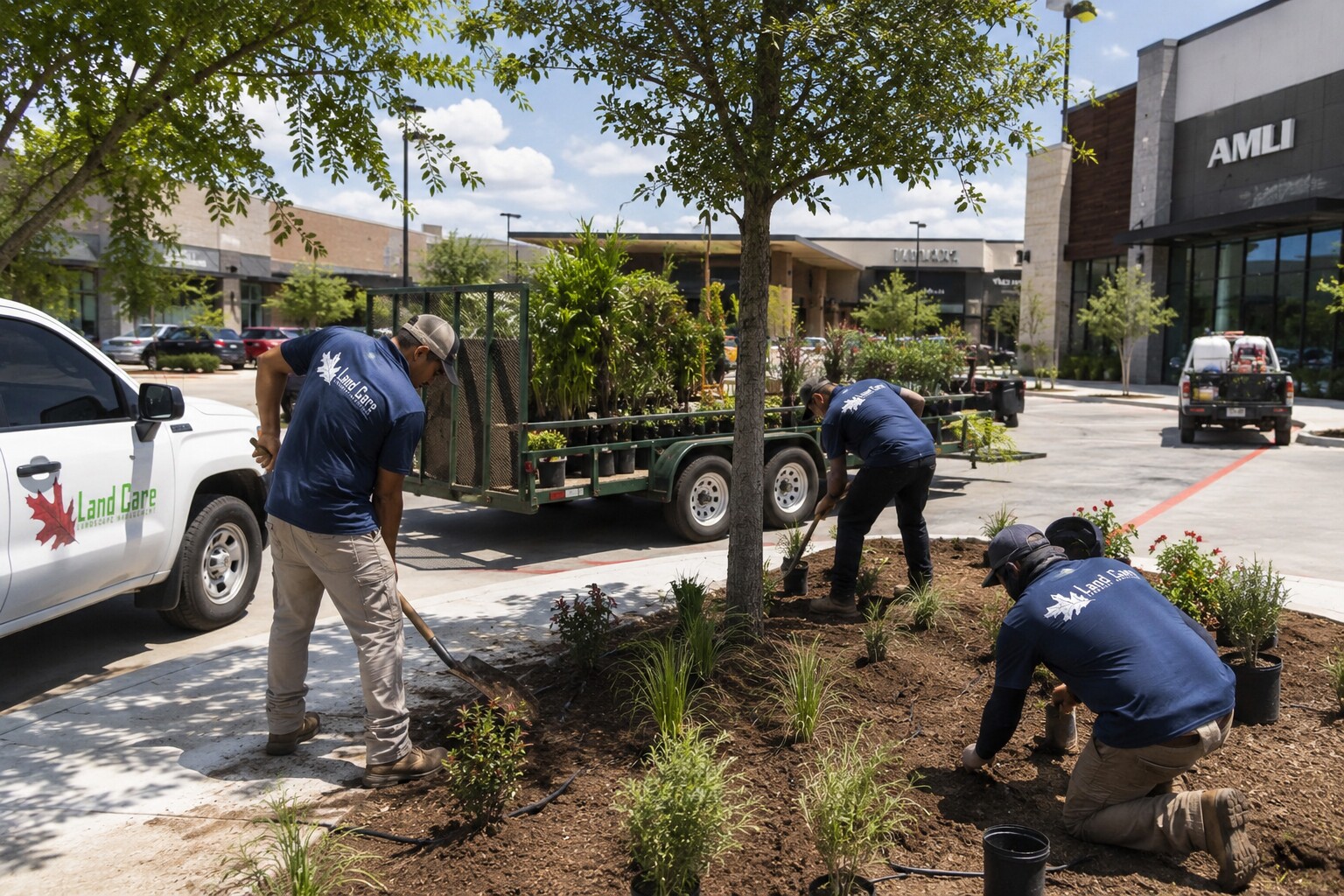
You should know who to call, by name
If your only contact is a phone number that routes to whoever answers, you do not have an account manager — you have a dispatch line. A commercial landscape partner should give you one named person who walks your property, knows its history, and answers directly. Ask who covers them on vacation. The answer tells you whether the company is built for commercial work or is scaling residential routes.
The same crew should be on your property
Crew consistency is not a comfort feature; it is the mechanism that catches problems. A crew that has mowed your campus for eight months notices that the turf by the north entrance is thinning before it becomes a bare patch, and knows which irrigation head the mower deck clipped last spring. Rotating crews reset that knowledge every visit, and the details are exactly what you are paying for.
Recommendations should arrive before problems do
The difference between a vendor and a partner is who notices first. You should be hearing about the drainage area that is spreading, the tree limb over the fire lane, and the color bed that is a season past its best — from your contractor, with a recommendation and a price, before a tenant emails you about it. If every conversation starts with you reporting something, the relationship is backwards.
Documentation should exist without you asking
Ask any contractor what you would receive in writing over a year: service records, irrigation inspection findings, ice event treatment logs, enhancement proposals. On a commercial property, that paper trail is not bureaucracy — it is what you hand ownership when they ask what the landscape budget bought, and what your risk manager wants after a slip-and-fall claim.
Licensing and insurance should be immediate, not eventual
In Texas, irrigation work must be performed under a TCEQ-licensed irrigator, and commercial pesticide and herbicide application requires Texas Department of Agriculture licensing. A contractor should be able to produce license documentation, a certificate of insurance naming your entity as additional insured, and a W-9 quickly. A slow answer here is itself the answer.
The warning signs a contract is drifting
Watch for: crews arriving at unpredictable times, cleanup getting sloppier at the edges of the property, unanswered emails that resolve only after a second follow-up, enhancement quotes that never arrive, and irrigation issues that get patched repeatedly instead of diagnosed. Individually they are small. Together they are the twelve-month slide that ends with a property nobody is proud of and a board asking hard questions.
Questions about your property? Call or text (972) 919-0054 — we’ll walk it with you.
Related Services
Put These Standards to Work on Your Property
Tell us what you’re managing and what’s not working. We’ll walk it and bring you a straight answer.