
What Xeriscaping Looks Like on a North Texas Commercial Property
Xeriscaping on a commercial or HOA site is a planned system of soil, plants, mulch and irrigation, not a pile of gravel. Here is where it fits in North Texas and what to ask before you approve a conversion.
Published November 5, 2026 · Land Care Landscape Management
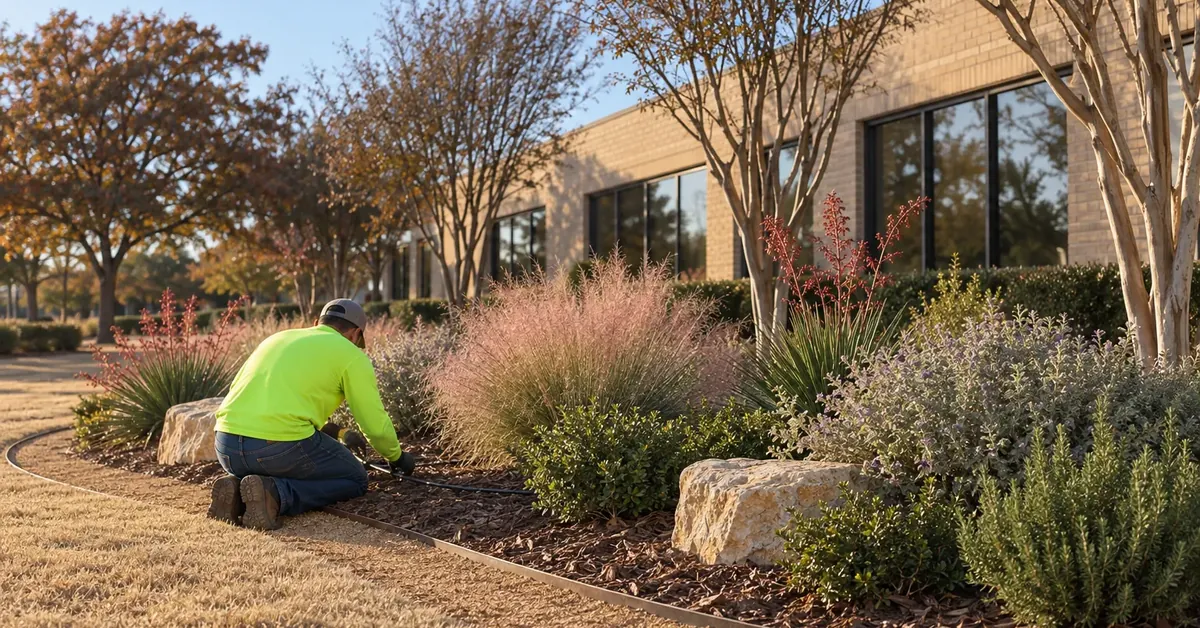
Xeriscaping on a North Texas commercial or HOA property means replacing high-water landscape areas with drought-tolerant plants, improved soil, mulch, and efficient irrigation, not gravel and cactus. It works best on turf strips, parking islands, and frontage beds. Before approving a conversion, ask about drainage, plant sourcing, irrigation changes, and establishment care.
What does xeriscaping mean on a commercial property in North Texas?
Xeriscaping is a design approach built around using less water. It has a few parts that work together: grouping plants by water need, preparing the soil, choosing plants suited to the region, mulching, and irrigating efficiently. Rock is one possible material, but it is not the point.
On a managed property, the goal is usually practical. You want beds that hold up through a Texas summer, need fewer irrigation adjustments, and still look kept to residents, tenants, and visitors. A good xeriscape has structure and color. It uses ornamental grasses, flowering perennials, evergreen shrubs, and defined edges so it reads as designed rather than neglected.
Where does xeriscaping make sense, and where does it not?
The best candidates are areas that are hard to water well or expensive to keep green:
- Narrow turf strips along streets and parking lots, where spray heads overshoot onto pavement
- Parking lot islands and medians that bake in reflected heat
- Steep slopes and berms where water runs off before it soaks in
- Entry beds that currently need heavy seasonal replanting
- Areas under thinning turf that never fully recovers
Some areas are better left as they are. Turf still makes sense where people walk, play, or gather, such as HOA common greens and event lawns. Deeply shaded areas under mature trees need shade-adapted plants, not sun-loving xeric ones. And any spot with standing water or poor drainage needs the drainage problem fixed first, because drought-tolerant plants often fail from wet roots faster than from dry weather.
How do DFW clay soil and summer heat shape the plan?
Much of North Texas sits on heavy clay. It drains slowly, cracks in dry spells, and holds water around roots after a big rain. That is why xeriscaping here is not just a plant swap. Soil prep and grading matter as much as the plant list.
A typical conversion on a clay site starts with removing or killing the existing turf, loosening the planting zone, and shaping the bed so water moves away from plant crowns. Raised or gently mounded beds help many xeric plants, and a drainage or grading fix may come before any planting. Bermuda turf is aggressive, so edges and bed prep need attention or it creeps back in from the rhizomes.
For plants, think about what handles both a hot summer and a wet, cold spell. Native and adapted choices such as Texas sage, red yucca, autumn sage, Gulf muhly, and little bluestem are common in this region, but the right list depends on sun, soil, and the look the property wants. Heat matters for materials too. Rock mulch near glass, brick, and pavement can radiate heat, so a good plan balances rock, shredded mulch, and plant cover instead of covering everything in stone.
What changes for irrigation and maintenance?
Water savings from xeriscaping depend on how the irrigation is handled. The existing system should be evaluated and adjusted as needed. Some zones may already suit the new beds, but leaving turf-level spray running on drought-tolerant plantings can undermine the savings and stress the plants. Many conversions involve moving beds to drip or low-volume zones, separating them from the turf zones, and checking pressure, coverage, and controller settings.
New plants are different in their first season. They need regular water while roots establish, then the schedule tapers. Planting in fall or early spring gives roots time to settle before peak summer heat. A mid-summer planting can be done, but it demands more watering and carries more risk.
Maintenance changes shape rather than disappearing. You will do less frequent property mowing in converted areas, but you will still need weed control in the beds, seasonal pruning, mulch top-ups, and regular irrigation inspections. Ornamental grasses and perennials are typically cut back once a year at the right time, not sheared constantly. If your current maintenance contract assumes turf, it should be updated to reflect the new scope.
How do you compare xeriscape proposals from contractors?
Proposals can look similar on the surface and differ a lot underneath. Before approving one, ask:
- What is the soil and drainage plan? Look for specifics on bed prep, grading, and how clay will be handled.
- How is the existing turf removed? Ask how Bermuda regrowth will be controlled.
- What is the plant list? You want names, quantities, mature sizes, and where the plants come from. Ask for healthy, regionally suitable stock. Species fit, root condition, planting practice, and aftercare all affect how well plants establish.
- What happens to the irrigation? The proposal should say whether zones are converted, retrofitted, or left alone.
- Who waters during establishment, and for how long? Make sure someone is responsible and that it is in writing.
- What does ongoing maintenance look like? Ask how the scope changes after conversion.
- Is there a rendering or design plan? For an HOA board, a visual makes approval far easier.
- Who is the single point of contact? Large conversions go better with one accountable person.
Also ask how the contractor handles plants that do not make it through the first year. Do not assume replacement is included. Get the answer in writing.
What should a phased conversion plan look like?
For a large property, a phased conversion can help spread costs and test plant performance before expanding, though a full conversion can make sense depending on site conditions, budget and construction scheduling. A phased plan starts with the areas that give the most return: the most irrigation overspray, the worst turf performance, or the most visible frontage. Those become the first phase, and the results tell you what works on your site.
A typical phased plan goes like this: start with a pilot area or one section, watch it through a full season including one hot stretch and one cold snap, adjust the plant palette or irrigation as needed, then schedule the next phases for fall or early spring planting windows. Phasing also spreads the work across budget cycles and gives residents time to see the new look before more of the property changes.
What should HOAs and managers check before approving changes?
For HOAs, check your governing documents and architectural review process early. Requirements for common areas and for approving landscape changes vary by community. For water use rules, such as watering days or irrigation requirements, check with your city or water provider, because they vary across North Texas.
Planning a conversion at your property
Our xeriscaping service covers design, plant installation, and rock bed work for commercial and HOA properties across the DFW area, and our sister company, the Land Care Garden Center in Flower Mound, is a retail garden center stocked with Texas natives, trees, and shrubs. If you are weighing a conversion, the best first step is to walk the property and pick the areas where it makes sense. You can reach out through our contact page and we will be glad to talk it through.
Frequently Asked Questions
Does xeriscaping mean rock and no plants?
No. A good xeriscape is planted with drought-tolerant shrubs, grasses, and perennials, with rock or mulch used as a ground cover where it makes sense. A bed that is mostly gravel tends to look bare and can hold heat against buildings and pavement.
Does a xeriscaped property still need irrigation?
Usually, yes. New plants need regular water while they establish, and many commercial sites keep a low-volume or drip system for dry spells afterward. The irrigation should be evaluated and adjusted to match the plants, since turf-style spray zones can waste water on xeric beds.
Can an HOA require approval for xeriscape changes?
Often, yes. Many communities have governing documents or an architectural review process that covers landscape changes, including in common areas. Requirements vary by community, so check your documents and bring a design rendering to the board.
How long does a xeriscape take to fill in?
Expect the first full growing season for plants to establish roots and begin filling in, with more mature coverage in the second season. Planting in fall or early spring helps. Slower-growing shrubs and grasses take longer than quick perennials.
Can xeriscaping be done in phases?
Yes, and on large properties it is often the better approach. Start with the areas that have the most overspray or the poorest turf, watch them through a season, then move on to the next section in a fall or early spring planting window.
Plan the Next Step For Your Property
Ask for a site walk to scope the work and timing that fit your property.